Indirect Nature of Income Taxes
COLLECTION AT THE SOURCE, Excise-Based Income Tax Policies
Indirect Income Taxation Policies
The original intent of federal income taxation was to tax those who had the ability to pay, which for the first 70 years of operation had subjected only two to five percent of the population.1 One of the founding principles of our Constitution was to free citizens of direct taxes unless emergencies should arise. Expectations were to tax duties, imports, and tariffs without resorting to direct taxes to fund the government.2 The founders’ apportionment rule was meant to make direct taxes on wealth difficult. 3 4
Our Constitution establishes income taxes, duties, and excises to be levied on economic events and not directed at individuals. The law of the land, embodied in our Constitution, requires that taxes on individuals must follow the rule of apportionment.5
A return to the original intent of income tax laws is to enforce “billionaires to pay taxes annually by eliminating the ability of high income and high net worth taxpayers to use tax planning strategies such as “buy, borrow, die” to defer paying taxes indefinitely…”6 “We The People”, the majority of the populace, suffer greatly under a “K- shaped” economy where there is a concentration of wealth in the top 3% of the population.7
The Constitution permits Congress to tax wage earners indirectly “at the source”, as a true excise tax, but prohibits levying various wage income tax provisions as a direct tax without apportionment. According to the IRS, foreign governments, and worldwide literature, the income tax is called a direct tax.8 9 By contrast, the Supreme Court has consistently ruled that the income tax is an indirect tax. 10 11
Class Struggle between Capital vs Labor
In 1894 the Supreme Court declared income derived from capital to be direct taxation requiring apportionment, while steadfastly holding that labor income, or income from earning wages, was forms of duties and/or excise taxes that fell under the classification of indirect taxation that need not be apportioned. This decision would have relieved real estate and invested personal property from income taxation, but instead declared the whole income tax act unconstitutional because that:
"...would leave the burden of the tax to be borne by professions, trades, employments, or vacations, and in that way what was intended as a tax on capital would remain, in substance, a tax on occupations and labor"Pollock v. Farmers' Loan & Trust Co., 157 U.S. 429 (1895) 15
The Supreme Court has told us that the 16th Amendment did not create or destroy the plenary powers of taxation, but only “that the Amendment was drawn for the purpose of doing away for the future with the principle upon which the Pollock case was decided.” 16 The Court further stated that:
“the contention that the Amendment treats a tax on income as a direct tax although it is relieved from apportionment and is necessarily therefore not subject to the rule of uniformity as such rule only applies to taxes which are not direct, thus destroying the two great classifications which have been recognized and enforced from the beginning, is also wholly without foundation since the command of the Amendment that all income taxes shall not be subject to apportionment by a consideration of the sources from which the taxed income may be derived forbids the application to such taxes of the rule applied in the Pollock case by which alone such taxes were removed from the great class of excises, duties, and imposts subject to the rule of uniformity, and were placed under the other or direct class. 17
The 16th Amendment allows Congress to levy income taxes without apportionment to directly overcome the obstacles that the Pollock decision presented. The Supreme Court recently reaffirmed that opinion with this:
“Because income taxes are indirect taxes, they are permitted under Article I, §8 without apportionment” (Moore v. US, 2024).
Therefore, the Sixteenth Amendment expressly confirmed what had been the understanding of the Constitution before Pollock: Taxes on income—including taxes on income from property—are indirect taxes that need not be apportioned. Brushaber, 240 U. S., at 15, 18.”
With unbroken and unwavering continuity, taxes on occupations and labor have always been classified as indirect taxes without any context or reference to the 16th Amendment; this remains the law of the land.18
Consequently, the IRS informs us that income taxes are, in fact, a direct tax.19 In contrast, the Supreme Court would allow the shift of indirect taxes to consumers:
As the means by which the burdens of taxes may be shifted are as multiform and as various as is the power to contract itself, it follows that the argument relied on, if adopted, would control almost every conceivable form of contract, and render them void if they had the result stated. Thus, the price of all property, the result of all production, the sum of all wages, would be controlled irrevocably by a law levying taxes if such a law forbade a shifting of the burden of the tax and avoided all acts which brought about that result. It cannot be doubted that to adopt by implication the view pressed upon us would be to virtually destroy all freedom of contract, and in its final analyses would deny the existence of all rights of property. American Express Co. v. Michigan, 177 U.S. 404 (1900)
In juxtaposition, the income tax is classified as an indirect tax by the Supreme Court; but does not escape the nature, function, and form, as a direct tax applied to vocations and wage earners in the form of creating personal liability, while prohibiting the very constitutional means to shift the burden of the tax back to the employer. In the final analysis, it is the employer who first pays all the costs of labor and production.
The income tax code should apply to "income" and not directly onto the individual; it is not a tax on wealth, but a tax excised on the creation of wealth through labor and/or capital in the marketplace.
“If it be true that, by varying the form, the substance may be changed, it is not easy to see that anything would remain of the limitations of the Constitution, or of the rule of taxation and representation, so carefully recognized and guarded in favor of the citizens of each State. But constitutional provisions cannot be thus evaded. It is the substance, and not the form, which controls, as has indeed been established by repeated decisions of this court.20
Indirect taxes were preferred by the framers of the Constitution, with Alexander Hamilton noting that indirect taxes “must always constitute the chief part of the revenue raised in this country.”21
Highlighted Reasons
- Increase revenue by “collection at the source” excise policies. 22
- Massively reduce the number of individual income tax filings. 23
- Massively reduce citizen hours of compliance and enforcement agents. 24
- Reduce intrusiveness into personal affairs under penalty of perjury. 25
- Savings in record-keeping freeing up billions of hours of record keeping. 26
- Free the burden of requiring most wage earners to file reports. 27
- Excise-based source withholding generates enforceability of collection on employers. 28
- Simplified Tax Compliance. 29
- Reduced Administrative Costs. 30
- More Predictable and Stable Government Revenue with Greater Equity and Consistency. 31
- Fewer Enforcement Actions Needed with Increased Taxpayer Satisfaction.
- Promote Economic Efficiency. 32
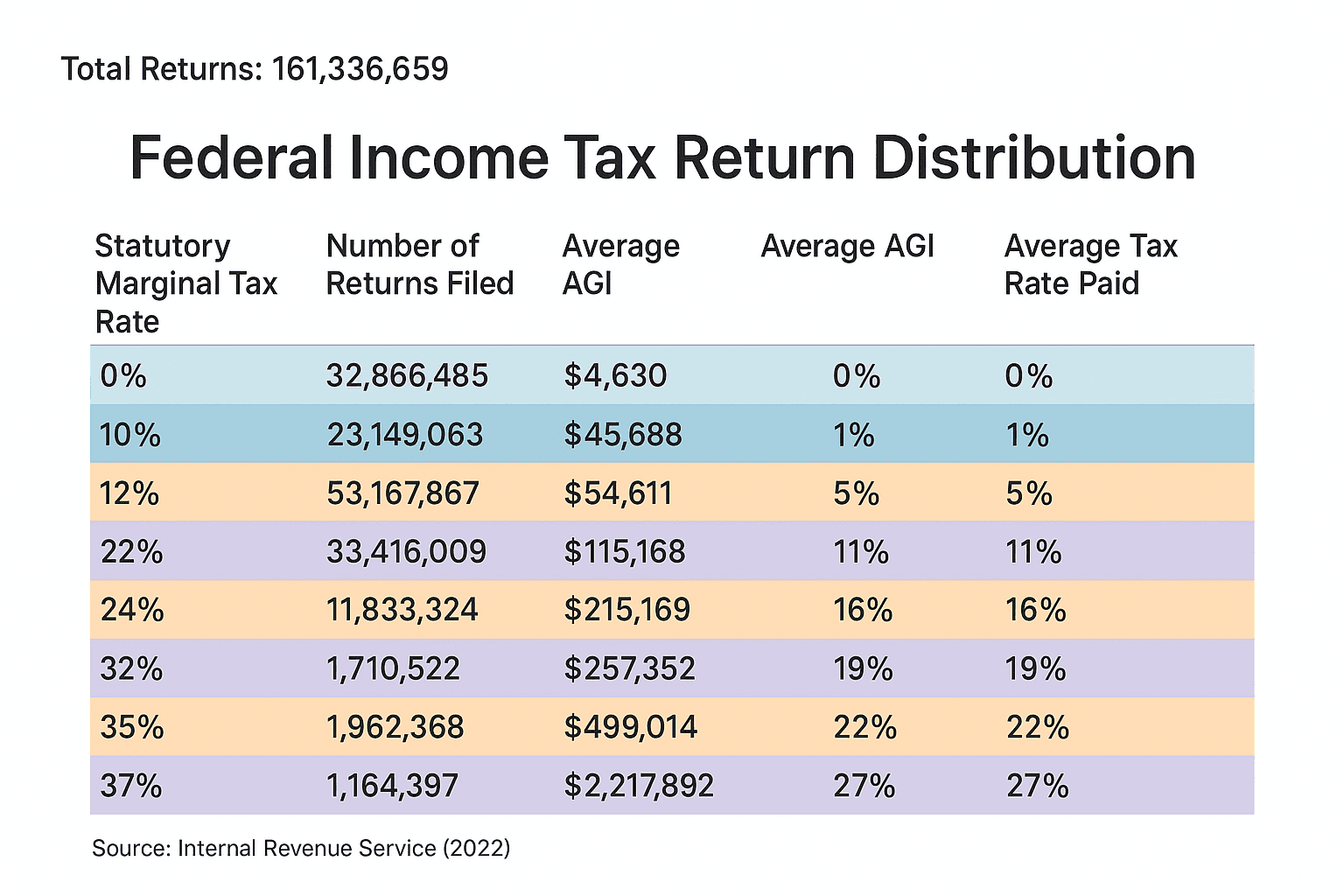
Removing Low Income Filers Proposal
Revenue would stabilize and increase as compliance reaches 100% with excise-based withholding at the source.
Removing filers who earn under $215,169 would remove over 150 million filers. (2022 most recent)
Footnotes
-
In 1894, a 2-percent income tax on those earning $4,000 or more a year, less than 1 percent of the population at the time. Teach Democracy ↩
-
Alexander Hamilton Federalist Number 21: ↩
-
The Records of the Federal Convention of 1787, Vol 2, August 25, 1787 ↩
-
“To state the obvious, that kind of complicated and politically unpalatable result has made direct taxes difficult.[Moore v. United States, 602 U.S. 572, (2024) ] (https://www.supremecourt.gov/opinions/23pdf/22-800_jg6o.pdf) ↩
-
“By contrast, indirect taxes are the familiar federal taxes imposed on activities or transactions. That category of taxes includes duties, imposts, and excise taxes, as well as income taxes.” [Moore v. United States, 602 U.S. 572, (2024) ] (https://www.supremecourt.gov/opinions/23pdf/22-800_jg6o.pdf) ↩
-
Around two‑thirds of Americans (about 67%) report living paycheck to paycheck according to PNC Bank’s 2025 Financial Wellness in the Workplace Report ↩
-
See: Springer v. United States, 102 U. S. 58 (1880) and Moore v. United States, 602 U.S. 572, p. 6, (2024) ↩
-
Federal Reserve Bank of St. Louis reports wealth holdings of the top 10% is over $117 trillion while the bottom 50% wealth holdings is under $10 trillion ↩
-
Alexander Hamilton Federalist #12, December 1787 ↩
-
Shifts timing forward: instead of reconciling millions of forms at year‑end, the tax is settled paycheck‑by‑paycheck with rare year‑end adjustments. IMF PAYE “properly designed PAYE means most employees do not need to file returns at all when wages are their main income. IMF, Tax Law Design and Drafting, vol. 1, ch. 15 “The Pay-As-You-Earn Tax on Wages” ↩
-
"In properly designed PAYE most employees do not need to file returns at all when wages are their main income." IMF, Tax Law Design and Drafting, vol. 1, ch. 15 “The Pay-As-You-Earn Tax on Wages” ↩
-
National Taxpayers Union Foundation (NTUF) estimates 6.55 billion hours spent complying with federal tax law in 2022, with a total burden of about $364 billion. – NTUF, “Complexity 2023: 6.5 Billion Hours, $260 Billion: What Tax Complexity Costs Americans” IRS paperwork alone is roughly two‑thirds of all federal paperwork hours across agencies. (NTU) ↩
-
Donald MacPherson, April 15th: The Most Pernicious Attack Upon English Liberty ↩
-
National Taxpayers Union Foundation estimates that in 2022 taxpayers spent 6.55 billion hours complying with federal tax law—recordkeeping, learning rules, filling out forms, etc.—with an imputed labor cost of $260 billion and out‑of‑pocket costs of $104 billion, for a total compliance burden of $364 billion per year.National Taxpayers Union ↩
-
“The tax gap can be a major source of inequity. Today’s tax code contains two sets of rules: one for regular wage and salary workers who report virtually all the income they earn; and another for wealthy taxpayers, who are often able to avoid a large share of the taxes they owe.” Dept. of Treasury, The Case for a Robust Attack on the Tax Gap ↩
-
Increases in revenue will result as compliance reaches 100%. Collection at the source, excised, is key to compliance. “Let me point this out now. Your income tax is 100 percent voluntary tax and your liquor tax is 100 percent enforced tax. Now the situation is as different as day and night.” Dwight E. Avis, Head, Alcohol and Tobacco Tax Division, Bureau of Internal Revenue, Internal Revenue Investigation, Hearings Before a Subcommittee of the Committee on Ways and Means, House of Representatives, 83rd Congress, 1st Session, on Administration of the Internal Revenue Laws, Part A, February 3, 1953. as reproduced in Wiebe Family for context ↩
-
OECD Forum on Tax Administration documents emphasize that digital tools, pre‑filled returns, and embedded tax in payroll “help reduce administrative burdens and free up taxpayers’ time.” – OECD, Tax Administration 2023 ↩
-
161,336,650 total returns in 2023, in contrast, IMF describes PAYE as requiring “relatively few administrative resources” while being of “great revenue importance.” ↩
-
Many IMF and World Bank tax administration guides highlight wage withholding as a key tool for providing stable revenue flows in developing and advanced economies alike.International Monetary Fund: 1998; Victor Thuronyi, ed ↩
-
Resources currently used in the annual tax preparation industry could be reallocated to more productive uses in the economy. ↩